Endodontist vs General Dentist for Root Canals
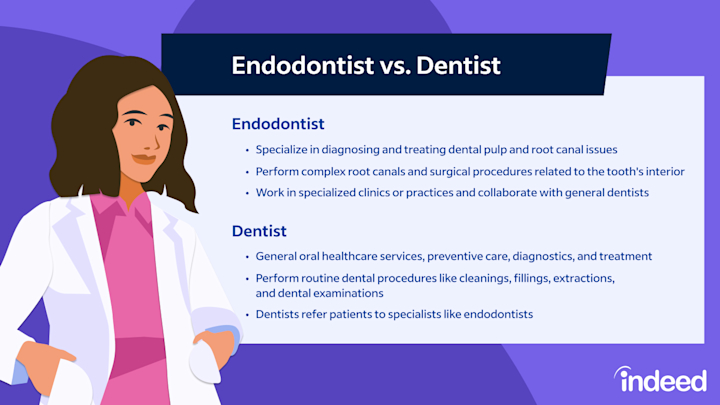
Should you see an endodontist or general dentist for your root canal? Compare training, equipment, cost, success rates, and when a specialist is worth it.
Reviewed by the toothcheck Dental Team Independent dentist providing online second opinions.
If you need a root canal, you have a choice: should you have it done by your general dentist or go to an endodontist (root canal specialist)?
Both are qualified to perform root canals, but there are real differences in training, equipment, cost, and outcomes. This guide helps you decide which is the right choice for your situation.
Quick Answer
- General dentist — Good for straightforward root canals on front teeth and premolars
- Endodontist — Better for complex cases, molars, retreatments, and diagnostic uncertainty
What Is an Endodontist?
An endodontist is a dentist who completed 2-3 years of additional specialty training focused exclusively on diagnosing tooth pain and performing root canal treatment. According to the American Association of Endodontists (AAE), endodontists perform an average of 25 root canals per week, compared to about 2 per week for a general dentist.
This difference in volume means endodontists develop deep expertise in:
- Complex root canal anatomy
- Difficult diagnoses
- Advanced retreatment techniques
- Managing complications
Key Differences: Endodontist vs. General Dentist
Training
- General dentist: 4 years of dental school. Root canals are part of training but not the primary focus
- Endodontist: 4 years of dental school + 2-3 years of specialty residency focused exclusively on root canals and tooth pain diagnosis
Equipment
- General dentist: Standard dental X-rays, basic root canal instruments
- Endodontist: Dental operating microscopes (10-25x magnification), CBCT 3D imaging, advanced ultrasonic instruments, specialized rotary file systems
The microscope is a significant advantage. It allows the endodontist to see root canal anatomy that's invisible to the naked eye, including:
- Extra canals (molars often have hidden canals)
- Cracks and fractures
- Calcified or curved canals
- Previous treatment that needs revision
Cost
- General dentist root canal: $800–$1,800
- Endodontist root canal: $1,000–$2,500
Endodontists typically charge 20-40% more, reflecting their additional training and equipment. However, if a general dentist starts a root canal and then needs to refer you to an endodontist mid-procedure, you may end up paying more overall.
For a full cost breakdown, see Root Canal Cost: What to Expect in 2026.
Success Rates
Both general dentists and endodontists achieve high success rates for straightforward cases. However, research published in the Journal of Endodontics consistently shows higher success rates for endodontists in complex cases:
- Straightforward root canals: Similar success rates (90-95%) for both
- Complex molars: Endodontists achieve higher success rates due to microscope use and experience with complex anatomy
- Retreatments: Endodontists are significantly more successful at retreating previously failed root canals
Time
- General dentist: Often requires 2 appointments
- Endodontist: Usually completed in 1 appointment (60-90 minutes)
When to Choose a General Dentist
Your general dentist is a good choice when:
- The tooth is straightforward — Front teeth and premolars with normal anatomy
- The diagnosis is clear — Obvious decay, clear X-ray evidence
- You trust your dentist's experience — They perform root canals regularly
- Cost is a primary concern — General dentists charge less
- Convenience matters — You already have a relationship with your dentist
Many general dentists are highly skilled at root canals. The key is knowing their comfort level — a good general dentist will refer complex cases to a specialist.
When to Choose an Endodontist
See an endodontist when:
- It's a molar — Molars have complex anatomy with 3-4 canals, some hidden
- The diagnosis is uncertain — If your dentist isn't sure what's causing your pain, an endodontist's diagnostic tools (CBCT, microscope) can provide clarity
- It's a retreatment — If a previous root canal failed, retreatment is significantly more complex
- Your tooth has unusual anatomy — Curved roots, calcified canals, extra canals
- Your general dentist recommends it — If they refer you, there's usually a good reason
- You have a cracked tooth — Endodontists are better equipped to diagnose and evaluate cracks
Questions to Ask Your General Dentist Before They Do Your Root Canal
1. "How many root canals do you do per month?" 2. "Do you use a microscope?" 3. "Would you refer this case to a specialist?" 4. "What's your success rate for this type of tooth?" 5. "What happens if complications arise during the procedure?"
A confident, experienced general dentist will answer these questions directly. If they seem hesitant or defensive, consider seeing a specialist.
Questions to Ask an Endodontist
1. "What does the CBCT scan show about my tooth's anatomy?" 2. "What's the prognosis for this specific tooth?" 3. "Is retreatment likely to succeed, or should I consider extraction?" 4. "How many appointments will this require?"
What If You're Not Sure You Need a Root Canal at All?
Before choosing between a general dentist and an endodontist, make sure the root canal is actually necessary. Common scenarios where it might not be:
- No pain or symptoms
- Inconclusive X-ray findings
- Pain only when chewing (could be a crack or bite issue)
- Fast diagnosis without proper testing
In these cases, an independent second opinion can save you the cost and irreversibility of an unnecessary procedure.
See Dentist Says I Need a Root Canal — What Should I Do? for a step-by-step guide.
FAQ
Is an endodontist better than a general dentist for root canals? For complex cases, yes. For straightforward cases, both achieve similar results. The key is matching the provider to the complexity of your case.
How do I find a good endodontist? The AAE's Find an Endodontist tool lets you search by location. You can also ask your general dentist for a referral.
Will my insurance cover an endodontist? Most dental insurance plans cover endodontic treatment at the same rate regardless of provider. Some plans require a referral from your general dentist. Check with your insurer.
Can a general dentist do a root canal on a molar? Yes, many general dentists are competent with molars. However, if the anatomy is complex (curved roots, calcified canals), or if it's a retreatment, an endodontist is the safer choice.
What happens if a general dentist's root canal fails? You'll likely be referred to an endodontist for retreatment or apicoectomy (surgical root canal). This is why some patients prefer to see an endodontist from the start for complex teeth.
Final Advice
The best provider for your root canal depends on your specific case:
- Simple case, clear diagnosis, front tooth → General dentist is fine
- Complex case, molar, retreatment, or diagnostic uncertainty → See an endodontist
And if you're not sure the root canal is necessary in the first place, get a second opinion before choosing any provider. An online dental second opinion can review your X-rays and help you understand whether the treatment is truly needed.
Last medically reviewed: April 2026