Root Canal Cost: What to Expect in 2026
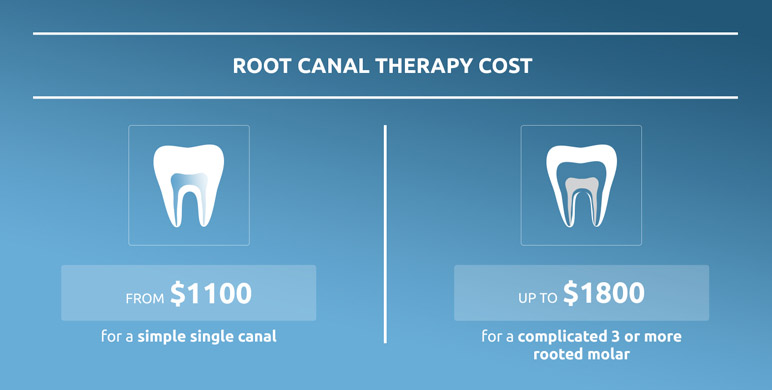
How much does a root canal cost? Get a complete breakdown of root canal prices by tooth type, with and without insurance, plus crown costs and how to save money.
Reviewed by the toothcheck Dental Team Independent dentist providing online second opinions.
If your dentist says you need a root canal, one of the first questions is: how much will this cost?
Root canals are one of the most expensive common dental procedures, and the total bill often includes a crown afterward — which can double or triple the final price. Understanding the real costs helps you make better decisions and avoid overpaying.
Quick Answer: Root Canal Cost by Tooth Type
Root canal costs vary significantly depending on which tooth is treated, and the crown afterwards is usually the larger half of the bill:
| Tooth | Root canal only | Crown | Typical total |
|---|---|---|---|
| Front tooth (incisor/canine) | $800–$1,200 | $1,000–$3,000 | $1,800–$4,200 |
| Premolar (bicuspid) | $900–$1,500 | $1,000–$3,000 | $1,900–$4,500 |
| Molar (back tooth) | $1,200–$2,500 | $1,000–$3,000 | $2,200–$5,500 |
Molars cost more because they have 3-4 root canals compared with 1-2 in front teeth, which makes the procedure longer and more technically demanding.
The single most useful thing to understand about this table is that the root canal is rarely the whole cost. A quote of $1,100 for a molar root canal is not a $1,100 decision if a $1,800 crown follows it six weeks later. Ask for both numbers up front.
According to the American Association of Endodontists (AAE), root canal treatment is almost always less expensive than tooth extraction followed by an implant, which typically costs $3,000–$6,000 for a single tooth.
Root Canal Cost With Insurance
Most dental insurance plans cover 50-80% of root canal costs after your deductible. Here's what that looks like:
- With 50% coverage: You pay $400–$1,250 out of pocket for the root canal
- With 80% coverage: You pay $160–$500 out of pocket
However, dental insurance typically has an annual maximum of $1,000–$2,000. If you need a root canal AND a crown in the same year, you may hit your annual cap quickly.
Important: Always verify coverage with your insurance provider before the procedure. Pre-authorization can prevent surprise bills.
Root Canal Cost Without Insurance
Without insurance, you'll pay the full fee, which varies by:
- Geographic location — Urban areas and coastal cities tend to charge more
- Provider type — Endodontists (specialists) typically charge 20-40% more than general dentists
- Tooth complexity — Molars with curved or calcified canals cost more
Ways to Reduce Cost Without Insurance
- Dental schools — Supervised procedures at 50-70% reduced rates. The American Dental Education Association (ADEA) maintains a directory of accredited dental schools
- Payment plans — Many offices offer interest-free financing
- Dental discount plans — Not insurance, but can reduce fees 20-40%
- Get a second opinion — Different providers may quote significantly different prices for the same work
What Should Be in the Quote
A root canal quote that is one number on a slip of paper is impossible to sanity-check. Ask for it itemised, and expect to see these lines separately:
- The root canal itself, priced per tooth and by tooth type. Ask which tooth by its number, so the fee matches the complexity.
- The crown, plus any core build-up if the remaining tooth structure is thin. A build-up is a legitimate charge, but it should be justified by what the X-ray shows.
- Diagnostic imaging — periapical films, or CBCT for a complex or curved-root case.
- Any temporary restoration between the root canal and the permanent crown.
- Retreatment terms, if the first attempt does not settle. Ask whether a retreatment would be charged again in full.
If a line item appears that you were not told about verbally, that is worth a question before you agree to anything. Our guide on how to read your dental treatment plan walks through a real plan line by line.
How to Check the Price for Your Own ZIP Code
National ranges are only a starting point. Dental fees are strongly local, and the same molar root canal can differ by more than a thousand dollars between two practices a few miles apart.
To check your own quote against local norms, look the procedure up on FAIR Health Consumer, which publishes cost estimates by procedure and ZIP code from actual claims data. Take the number your dentist quoted, compare it with the range for your area, and treat a large gap as a question rather than a verdict — a higher fee can be legitimate for a genuinely complex tooth.
The full price-check method is in Is My Dentist Overcharging Me?.
What Happens to the Cost If You Wait
Delaying a genuinely necessary root canal rarely makes it cheaper. An untreated infected pulp does not settle on its own, and the realistic paths from there are more expensive, not less:
- The tooth becomes unrestorable, moving you from a root canal and crown to extraction plus an implant — which the American Association of Endodontists notes typically costs more than saving the tooth.
- An acute flare-up sends you to emergency or out-of-hours care, which is priced well above a planned appointment.
- Infection spreading into surrounding bone turns a single-tooth problem into a larger one.
None of this means you should agree on the spot. It means the useful move when you are unsure is to get the diagnosis checked quickly rather than to postpone the decision indefinitely.
When a Root Canal Isn't Worth the Cost
A root canal isn't always the best investment. Consider alternatives when:
- The tooth has a poor prognosis — Severe cracks, insufficient remaining tooth structure, or advanced gum disease may mean the tooth won't last even with treatment
- The cost exceeds extraction + implant — In rare cases, especially for severely compromised molars
- The recommendation is uncertain — If your dentist seems unsure, a second opinion can prevent spending $2,000+ on a procedure you may not need
For a deeper look, see Root Canal vs. Alternatives: When Each Makes Sense.
Endodontist vs. General Dentist: Cost Difference
- General dentist: $800–$1,800 for the root canal
- Endodontist: $1,000–$2,500 for the root canal
Endodontists charge more, but they're specialists with advanced equipment (microscopes, CBCT imaging). For straightforward cases, a general dentist may be sufficient. For complex molars or retreatments, an endodontist is often worth the extra cost.
See Endodontist vs. General Dentist for Root Canals for a detailed comparison.
How a Second Opinion Can Save You Money
A second opinion costs a fraction of the procedure itself but can save you thousands:
- Confirming necessity — Prevents paying for a root canal you don't need
- Price comparison — Different providers quote different prices
- Alternative treatments — A simpler (cheaper) treatment may be sufficient
- Avoiding unnecessary crowns — Not every root canal tooth requires a $1,500+ crown
Variation between dentists looking at the same case is well documented in the peer-reviewed literature — our dental second opinion statistics page sets out the specific studies and what each of them actually measured, rather than a single headline number.
FAQ
Is a root canal cheaper than an implant? Almost always. A root canal + crown costs $1,800–$5,500, while extraction + implant + crown costs $3,000–$6,000+. Root canals also avoid the 3-6 month healing period implants require.
Does insurance cover the crown after a root canal? Usually yes, at 50-80% coverage, but it may push you past your annual maximum. Check with your insurance provider. For a full breakdown of what the crown portion should cost — by US state and internationally — see How Much Does a Dental Crown Cost in 2026?.
Can I get a root canal at a dental school? Yes. Accredited dental schools offer root canals at significantly reduced rates, supervised by experienced faculty. Treatment may take multiple visits.
How can I tell if I'm being overcharged? Get an itemized treatment plan and compare it with average costs in your area. If the quote is significantly above average, get a second opinion. The full price-check playbook is in Is My Dentist Overcharging Me?.
Is the cheapest root canal always the best option? No. Very low prices can indicate rushed treatment or inexperienced providers. Focus on value: fair pricing from a qualified dentist who explains the procedure clearly.
Final Advice
A root canal is a significant dental expense, but it's also an investment in keeping your natural tooth. Before committing:
- Get an itemized cost breakdown
- Verify your insurance coverage
- Compare prices between providers
- Consider a second opinion, especially if the cost seems high
If you're unsure whether a root canal is necessary — or whether the quoted price is fair — an online dental second opinion can help you decide before spending thousands.
Last medically reviewed: September 2026