How Are Teeth Numbered? A Complete Guide
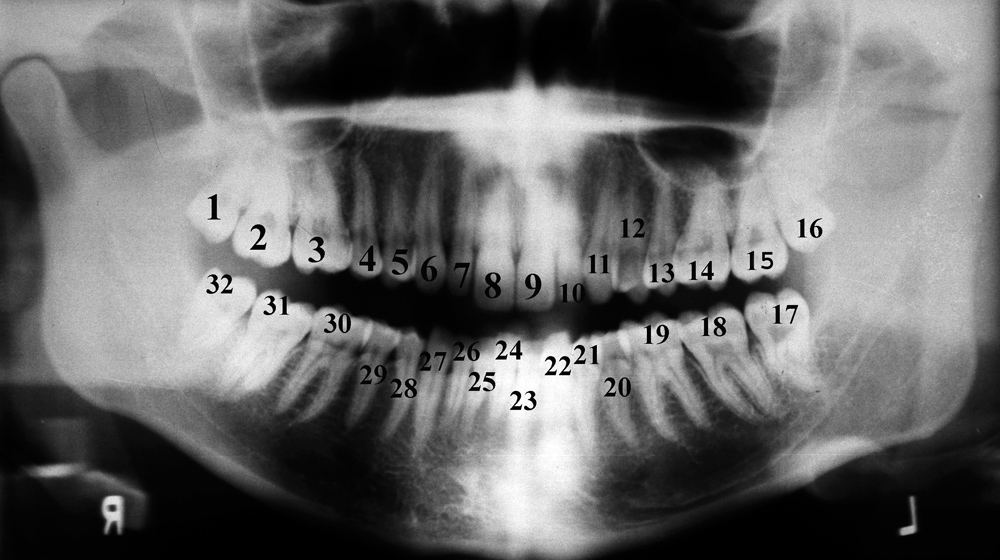
A complete, plain-English guide to how teeth are numbered - the US Universal system (1-32), the international FDI system, and baby teeth - with real X-rays and charts.
Reviewed by the toothcheck Dental Team Independent dentist providing online second opinions.
Every tooth on a dental chart or X-ray has a number - but there is more than one way to number them, which is why the same tooth can be "3" at one practice and "16" at another. This is a plain-English guide to everything you need to know about tooth numbering: the US Universal system, the international FDI system, and how baby teeth are handled, all shown on real X-rays and charts so you can read any chart with confidence.
Quick Answer
Two systems cover almost every dental chart you will see:
- Universal Numbering System (used in the US): the 32 adult teeth are numbered 1 to 32 in one continuous sweep - the upper-right wisdom tooth is 1, across the top to the upper-left wisdom tooth (16), then down to the lower-left wisdom tooth (17) and back across to the lower-right (32). Baby teeth are lettered A to T.
- FDI notation (used in most of the world): each tooth gets two digits - the first is the quadrant (1 upper-right, 2 upper-left, 3 lower-left, 4 lower-right) and the second is the position from the midline (1 = central incisor, out to 8 = wisdom tooth). So "16" is quadrant 1, tooth 6 - the upper-right first molar - read aloud as "one-six."
Both name the same teeth; they just label them differently.
The Universal Numbering System (United States)
On an X-ray, the Universal count runs as one loop: across the top 1 to 16, then straight down and back across the bottom 17 to 32.
Your two upper front teeth are 8 and 9; the two lower front teeth are 24 and 25. Laid out as a chart, the same system also shows how baby teeth are lettered A to T:
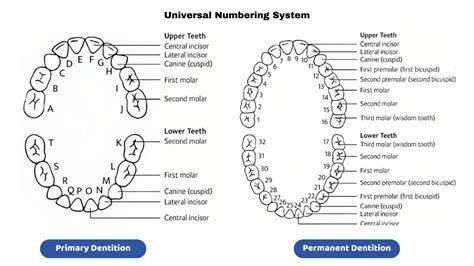
The FDI System (International)
The FDI system packs two pieces of information into two digits: the first tells you the corner of the mouth, the second tells you the tooth. Every upper-right tooth starts with 1, upper-left with 2, lower-left with 3, and lower-right with 4.
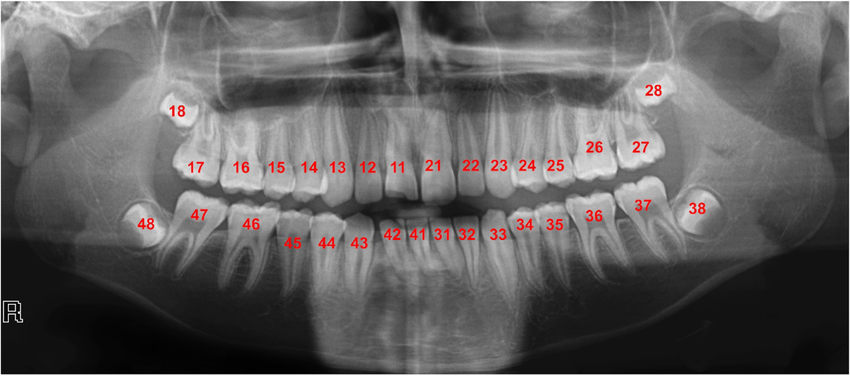
Read the two digits separately - "one-six," not "sixteen." The four first molars are 16, 26, 36 and 46:
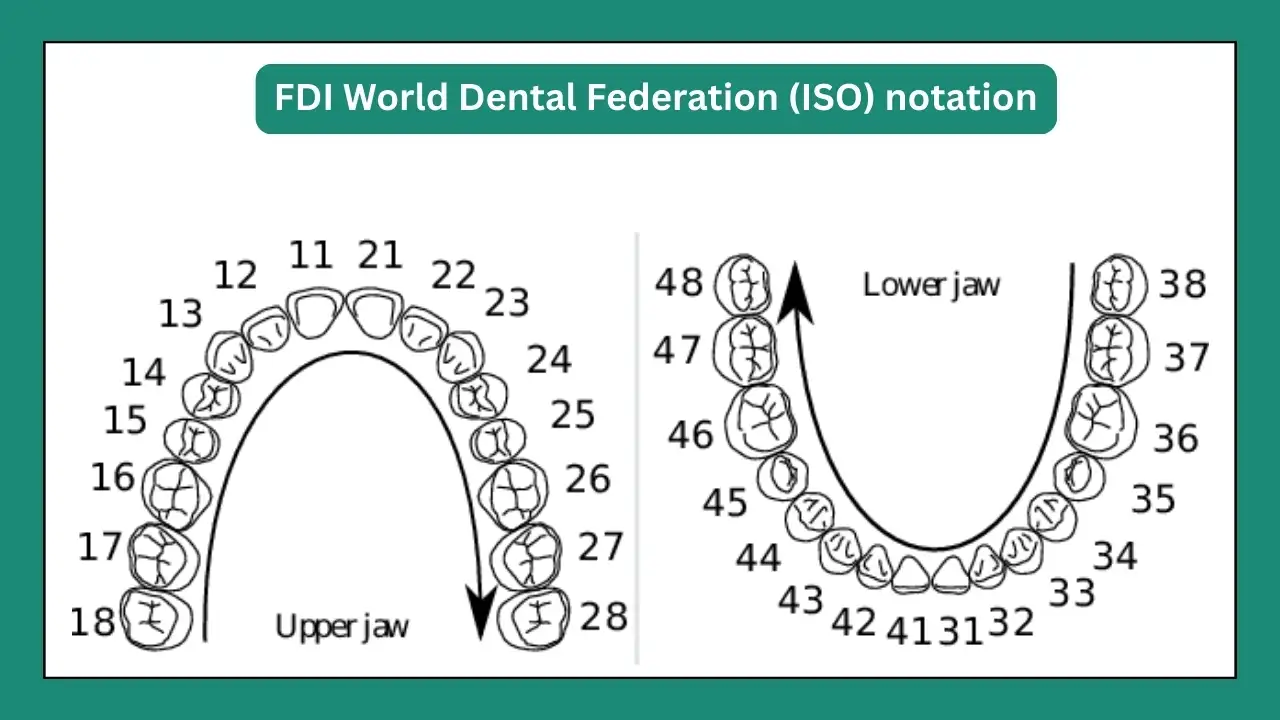
The Same Number Can Mean Different Teeth
Because the two systems use the same digits differently, one number can point to two different teeth: "16" is the upper-right first molar in FDI, but the upper-left wisdom tooth in the Universal system. A few common teeth in both systems:
- Upper-right first molar - Universal 3 / FDI 16
- Upper-left first molar - Universal 14 / FDI 26
- Upper front teeth (central incisors) - Universal 8 and 9 / FDI 11 and 21
- Lower-right first molar - Universal 30 / FDI 46
- Wisdom teeth - Universal 1, 16, 17, 32 / FDI 18, 28, 38, 48
Children's (Baby) Teeth
Children have 20 primary teeth. In the Universal system they are lettered A to T; in FDI they keep the two-digit format but use quadrant digits 5 to 8 (so an upper-right primary central incisor is 51). The Universal chart earlier on this page shows the full A-to-T layout for baby teeth.
Why Tooth Numbering Matters
Knowing how teeth are numbered lets you follow your own dental chart, match each line on a treatment plan to the exact tooth, and read records or an X-ray from anywhere in the world. For help interpreting the findings themselves, see how to read your dental X-rays and how to read your treatment plan; for a quick refresher on finding a specific tooth in the US system, see which tooth is #14, #19, or #30.
Whatever numbering your chart uses, if you want to be sure the treatment on it is necessary and correctly identified, upload your X-rays for an independent second opinion or a dental treatment plan review.
FAQ
How are teeth numbered? Most dental charts use one of two systems. The US Universal system numbers the 32 adult teeth 1 to 32 in a single sweep around the mouth (and letters A to T for baby teeth). The international FDI system gives each tooth a two-digit number - quadrant first, position from the midline second.
Why is my tooth a different number on a foreign dental chart? Because that chart almost certainly uses the FDI system rather than the US Universal system. An upper-right first molar is 3 in Universal but 16 in FDI - the same tooth, a different convention.
Does 16 mean the same tooth in both systems? No. In FDI, 16 is the upper-right first molar; in the Universal system, 16 is the upper-left wisdom tooth. The same two characters mean different teeth depending on the system.
How are children's baby teeth numbered? In the Universal system the 20 primary teeth are lettered A to T. In FDI they keep the two-digit format but number the quadrants 5 to 8, so an upper-right primary central incisor is 51.
Last medically reviewed: July 2026