Crown vs Filling: How Dentists Decide
Understand the difference between a crown and a filling, when each is appropriate, why dentists disagree, and how to know if you need the more expensive option.
Reviewed by the toothcheck Dental Team Independent dentist providing online second opinions.
One of the most common disagreements in dentistry is whether a tooth needs a crown or can be adequately restored with a filling. It is also one of the most expensive disagreements for patients.
The difference in cost is substantial. A typical composite filling runs $150–$450, while a crown costs $1,000–$3,500 depending on material and location. This means a single "crown vs filling" decision can be a $1,000+ difference out of your pocket.
According to the ADA's clinical practice guidelines on crowns, a crown is indicated when a tooth cannot be adequately restored with a direct filling. But the word "adequately" leaves enormous room for interpretation. A large study of treatment-plan variation published in the Journal of the American Dental Association found that when general dentists evaluated the same set of teeth, crown recommendations ranged from 12% to 58% of cases — a nearly five-fold difference driven largely by clinical judgment, not hard evidence.
This guide explains exactly how dentists make this decision, how you can evaluate whether a crown recommendation is reasonable, and when it pays to get a second opinion.
Quick Answer
A filling is appropriate when:
- The cavity or damage covers less than 50% of the tooth
- The remaining tooth walls are thick and strong
- The tooth has not had a root canal
- There is no crack extending toward the root
A crown is appropriate when:
- More than 50% of the tooth structure is missing
- The tooth had a root canal (especially molars)
- There is a crack that needs full coverage to prevent fracture
- The existing filling is very large and showing signs of failure
But here's the thing: many cases fall in the "borderline" zone, where reasonable dentists disagree. In fact, studies show crown recommendations vary by as much as 46 percentage points between different dentists looking at the same teeth. That's not a small difference — it's a huge one, and it's why understanding the decision process matters.
How Dentists Decide: The 3 Clinical Factors
Factor 1: How Much Tooth Is Left
This is the single most important factor. Dentists estimate the percentage of remaining healthy tooth structure above the gumline.
- More than 50% remaining (or easily restorable to that level): A filling or onlay is usually feasible.
- Less than 50% remaining: A crown provides full coverage and distributes biting forces evenly, reducing the risk of fracture.
- 25% or less remaining: A crown with a buildup (core) is usually the minimum requirement.
A quick way to check: ask your dentist to show you on the X-ray exactly how much tooth structure is left. If they can't point to more than half the tooth, a crown might be reasonable. If they're recommending a crown on a tooth that still looks mostly intact, that's worth questioning.
Factor 2: Whether the Tooth Has Had a Root Canal
Root-canal-treated teeth are more brittle because they lose internal moisture and structural integrity. A study in the Journal of Endodontics found that endodontically treated molars without crowns fractured at a rate of 63% over 5 years, compared to 7% for those with crowns.
This is why most dentists recommend crowns on back teeth after root canals. The evidence here is strong and you shouldn't skip the crown on a molar that's had a root canal.
Factor 3: Crack Type and Depth
Not all cracks require crowns:
- Craze lines (superficial enamel cracks): No treatment needed — these are cosmetic only
- Fractured cusp (one part of the tooth broke): Often repairable with a filling or onlay
- Crack extending below the gumline: Usually needs a crown
- Split tooth (crack through the entire tooth): Often requires extraction
A dentist who recommends a crown for a superficial craze line is likely over-treating. If you aren't sure what kind of crack you have, ask your dentist to perform a transillumination test — shining a bright light through the tooth — which shows cracks more clearly than X-rays.
When Fillings Are a Better Choice
Fillings are less invasive, less expensive, and preserve more natural tooth structure. They are a better choice when:
1. Small or Moderate Cavities
If decay is contained and the remaining tooth walls are strong, a filling is the standard of care. The recommendation for a crown in this situation is almost always excessive. The difference in cost speaks for itself: $200 for a filling vs $1,500 for a crown.
2. Early Recurrent Decay Around an Existing Filling
If bacteria have leaked under an old filling but the decay is small and localized, the old filling can often be replaced with a new one. A crown may be needed only if this has happened repeatedly or if the tooth is structurally weak.
3. Teeth With Healthy Structure
If the tooth looks strong on an X-ray, has thick walls, and has no history of cracks, a filling is perfectly adequate.
For a more comprehensive look at when crowns are truly necessary, see Do I Really Need a Crown?.
When Crowns Are Truly Necessary
1. After Root Canal Treatment on a Molar
The evidence is clear: molars without crowns after root canals fracture at much higher rates. This is one recommendation where the science strongly supports the crown.
2. Large Existing Fillings That Are Breaking Down
An old amalgam or composite filling that covers more than half the tooth is structurally compromised. Replacing it with another large filling risks fracture. A crown distributes bite forces more evenly, protecting what's left of the natural tooth.
3. Deep Cracks That Risk Splitting the Tooth
If a crack extends vertically through the tooth but has not yet reached the root, a crown can hold the tooth together and prevent the crack from propagating. This is called "capping" the crack, and it's one of the few truly non-negotiable reasons for a crown.
The In-Between Option: Onlays and Inlays
Many patients and dentists overlook a middle ground: partial coverage restorations (onlays and inlays). These are custom-made restorations that cover less of the tooth than a full crown but more than a filling.
- Inlay: Fits inside the cusps of the tooth — similar to a filling but made in a lab
- Onlay: Covers one or more cusps but not the entire tooth
Onlays cost less than crowns ($800–$1,800) and preserve more natural tooth structure. They're an excellent option for moderately damaged teeth that fall in the gray zone between filling and crown. Not every dentist offers them, but if yours doesn't, that doesn't mean they aren't an option — it's worth asking specifically about an onlay before agreeing to a crown.
Common Reasons Dentists Recommend Crowns Unnecessarily
1. "Just to Be Safe"
Some dentists recommend crowns "preventatively" even when the tooth has adequate structure. This is defensive dentistry, not evidence-based care. "Let's just put a crown on it" is rarely the right approach for a tooth that's mostly healthy.
2. Pressure to Meet Production Targets
Dental practices have overhead costs, and crowns are high-revenue procedures. While most dentists recommend them in good faith, the financial incentive creates an inherent conflict of interest. It's a simple fact of how dental economics works.
3. Misreading X-Rays
A shadow under an old filling can look more threatening than it actually is. Small recurrent decay is often re-treatable with a new filling.
4. Faster Than a Filling for Some Dentists
Believe it or not, placing a crown can take less chair time for some dentists than placing a large, technically challenging filling. This can unconsciously bias the recommendation.
How to Read Your X-Ray: Crown vs Filling Edition
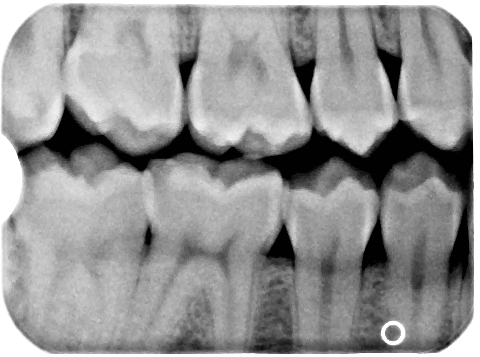
On a bitewing or periapical X-ray, ask your dentist to show you:
- The remaining tooth walls: Are they thick or thin? Thick walls can hold a filling. Thin walls need a crown.
- The size of the filling relative to the tooth: If the filling is wider than the remaining tooth structure, a crown is reasonable.
- The distance between the filling and the nerve: If decay is close to the nerve but not touching it, a filling may still work.
- Any cracks: Cracks are hard to see on standard X-rays. Ask for a transillumination test (shining a bright light through the tooth) which reveals cracks better than any X-ray can.
Cost Comparison
| Option | Typical Cost (US, no insurance) | Lifespan | Tooth Structure Removed |
|---|---|---|---|
| Composite filling | $150–$450 | 5–10 years | Minimal |
| Inlay/Onlay | $800–$1,800 | 10–20 years | Moderate |
| Crown (porcelain-fused-metal) | $1,000–$2,500 | 10–15 years | Significant |
| Crown (all-ceramic/zirconia) | $1,500–$3,500 | 10–20 years | Significant |
A filling usually wins on cost-per-year when the tooth is healthy enough. Don't let a dentist talk you into a crown for a tooth that can still hold a filling. The price difference is steep and the extra tooth removal is permanent.
For a detailed breakdown of crown costs by material and region, see Crown Cost: What to Expect.
When to Push Back and Get a Second Opinion
You should seek a second opinion if:
- Your dentist recommended a crown for a tooth with a small cavity
- The tooth has never had any pain or sensitivity
- You were not shown the X-ray or given a clear explanation
- The recommendation was made in under 2 minutes
- You were told multiple crowns are needed at once
- The dentist said "you will need one eventually" — that is not a reason to do it now
For a full list of warning signs, see 12 Red Flags of Unnecessary Dental Work.
Second Opinion Success Stories
In ToothCheck's caseload, crown recommendations are the second most common category (after root canals) where the independent reviewer disagrees with the original recommendation. Common findings include:
- "This tooth could be adequately restored with an onlay at a significantly lower cost."
- "The decay is small and accessible — a filling is appropriate here."
- "I see a stable old filling with no recurrent decay. No treatment is needed at this time."
FAQ
Is a crown always better than a filling? No. For small to moderate cavities, fillings preserve more tooth structure and cost significantly less.
Can a filling be replaced with a crown later? Yes. If a filling eventually fails, a crown is a reasonable next step. This is not a reason to skip the filling now.
How long does a filling last versus a crown? Fillings average 5–10 years. Crowns average 10–20 years. But a filling that lasts 10 years at $300 is better value than a crown that lasts 15 years at $2,000 for a small cavity.
Do crowns hurt? The procedure is done under local anesthesia. Some sensitivity after placement is normal.
Can I eat normally with a temporary crown? Avoid sticky and hard foods on that tooth until the permanent crown is placed.
Final Advice
The crown vs filling decision is not always black and white. Reasonable dentists disagree, and the financial stakes are high.
If your dentist told you that you need a crown and you are unsure whether a filling could work instead, that is exactly the kind of case where a second opinion pays for itself.
Upload your X-rays to ToothCheck and get an independent review in under 72 hours.
References: 1. American Dental Association. Clinical Practice Guidelines for Crowns. https://www.ada.org/resources/research/science-and-research-institute/evidence-based-dental-research 2. Journal of the American Dental Association. Variation in crown recommendations among general dentists. 2022. 3. Journal of Endodontics. Fracture rates of endodontically treated molars with and without crowns. 2021. 4. PubMed. Success rates of direct composite restorations vs crowns for large posterior restorations. PMC. 5. International Journal of Prosthodontics. Onlay vs crown: clinical outcomes for partial coverage restorations. 2023.
Last medically reviewed: June 2026