My Root Canal Failed — Now What? Your Options Explained
Your root canal failed. Learn why root canals fail, how to tell if yours has failed, and what your treatment options are — from retreatment to apicoectomy to extraction.
Reviewed by the toothcheck Dental Team Independent dentist providing online second opinions.
Quick Answer: A Failed Root Canal Does Not Mean You Have to Lose the Tooth
A failed root canal has four treatment options, and only one of them involves losing the tooth:
1. Root canal retreatment — The most common option. An endodontist removes the old filling material, cleans the canals again with advanced instruments, and seals it properly. 2. Apicoectomy — A minor surgical procedure where the tip of the root is removed and sealed from the other end. 3. Extraction with replacement — Removing the tooth and replacing it with an implant or bridge. 4. Monitoring (watch and wait) — Appropriate in limited cases with no symptoms or progression.
Of these, retreatment is almost always the first choice for teeth that are otherwise restorable. The key question is whether the tooth has enough remaining structure to support a new restoration.
Few words in dentistry spark as much frustration as "your root canal has failed."
After investing time, money, and discomfort into saving a tooth, hearing that the infection has returned is disheartening. But a failed root canal is not the end of the road for that tooth — and it does not automatically mean extraction is your only option.
Root canal treatment has an excellent long-term success rate. According to the American Association of Endodontists (AAE), root canal treatment succeeds in approximately 85–97% of cases. When a root canal does fail, the remaining options depend on why it failed, which tooth is involved, and what condition the tooth is in.
This guide explains exactly why root canals fail, how to recognize failure, and what your options are — including retreatment, apicoectomy, and extraction — so you can make an informed decision about what comes next.
If your dentist told you your root canal has failed and you are unsure how to proceed, an online dental second opinion can help you choose the right option. The right choice depends on the cause of failure, the tooth's restorability, and your personal preferences.
For a detailed comparison of root canal treatment options, see Root Canal vs. Alternatives: Complete Comparison.
Why Do Root Canals Fail?
Understanding why a root canal failed helps determine what the best next step is.
1. Missed or Untreated Canals (Most Common Cause)
Human teeth do not always have a predictable number of canals. An upper molar typically has three or four canals; a lower molar has two or three. Anatomical variations are common, and sometimes a canal is curved, narrow, or hidden in a way that makes it easy to miss.
A missed canal harbors bacteria that continue to cause infection. According to research published in the Journal of Endodontics, missed canals are one of the leading causes of endodontic failure, especially in maxillary molars where a fourth canal (the MB2, or second mesiobuccal canal) is present in 50–90% of cases but is frequently missed during initial treatment.
Retreatment with a dental operating microscope significantly improves the detection and treatment of these missed canals.
2. Complex Root Anatomy
Even when all canals are located, curved or calcified canals can be difficult to clean completely. Bacteria can persist in areas the instruments could not reach, leading to a persistent infection.
3. Coronal Leakage
After a root canal, a crown or filling is placed on top of the tooth to seal it from the mouth. If this restoration leaks — due to decay, a crack, or a defective crown — bacteria from the mouth can re-enter the root canal system and cause re-infection.
This is the reason a well-sealed crown is important after root canal treatment. For the cost of crowns and what they entail, see Root Canal Cost: What to Expect in 2026.
4. New Decay or Fracture
A root-canal-treated tooth is more brittle than a vital tooth. It can crack or develop new decay at the margin of the crown. If the crack extends into the root, retreatment may not be an option.
5. Incomplete Initial Cleaning
Even in a well-performed root canal, the complex system of microscopic tubules inside a tooth can harbor bacteria. Modern techniques — including irrigation with sodium hypochlorite, ultrasonic activation, and the use of calcium hydroxide as an intracanal medicament — improve the odds, but no root canal can guarantee 100% sterility.
6. Persistent Extraradicular Infection
Rarely, bacteria establish themselves outside the root tip (in the bone surrounding the tooth) where root canal instruments cannot reach. In these cases, the infection persists even after a technically excellent root canal.
7. Cyst Formation
A radicular cyst — a fluid-filled sac at the tip of the root — can sometimes persist even after the root canal is complete. While most cysts heal after successful root canal treatment, some require surgical removal.
Signs Your Root Canal May Have Failed
A failed root canal does not always cause pain. In fact, some failures are discovered incidentally on routine X-rays with no symptoms at all. But when symptoms do appear, they typically include:
- Pain or tenderness when chewing or biting on the tooth
- Persistent or recurring swelling of the gum near the treated tooth
- A pimple-like bump on the gum (fistula or sinus tract) that may drain pus
- Sensitivity to pressure or a feeling that the tooth is "high"
- Discoloration of the tooth (though this can also be normal after a root canal)
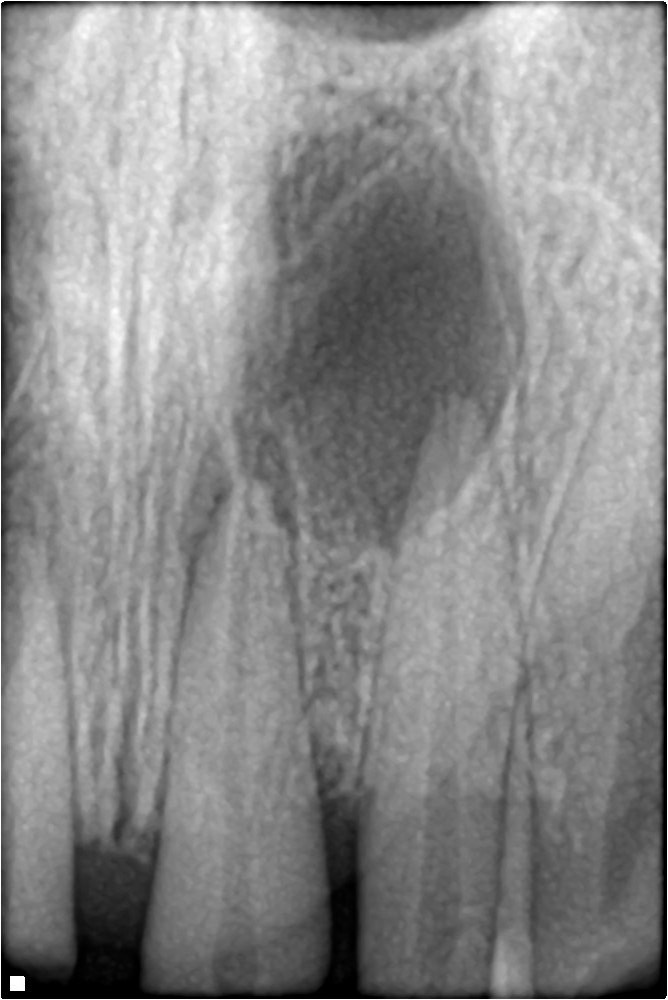
- No symptoms but an X-ray finding — a dark area (radiolucency) at the tip of the root that has not healed or has grown larger over time
According to the AAE's clinical guidance on retreatment, the most reliable indicator of failure is the presence of a periapical radiolucency that persists or enlarges on follow-up X-rays, especially when combined with clinical symptoms.
If you have any of these symptoms after a root canal, it is reasonable to have the tooth re-evaluated. For guidance on when a second opinion is smartest, see Dentist Says I Need a Root Canal — What Should I Do?.
How Long After a Root Canal Can It Fail?
Root canals can fail at any time:
- Early failure (within 1–2 years): Usually due to missed canals, incomplete cleaning, or coronal leakage
- Mid-term failure (2–5 years): Often caused by a cracked tooth or recurrent decay under the crown
- Late failure (5–15+ years): Typically from new decay, a fractured restoration, or gradual breakdown of the root canal seal
Even a root canal that was successful for 20 years can eventually fail if the crown leaks or the tooth fractures. This does not mean the original treatment was poorly done — it means the tooth has lived its useful life and may need further intervention.
Option 1: Root Canal Retreatment
Root canal retreatment — also called endodontic retreatment — is the most common and preferred option for a failed root canal. It is the same type of procedure as the original root canal, but more complex because the existing root canal filling material must be removed first.
Who Is a Good Candidate for Retreatment?
- The tooth has adequate remaining structure and the crown is still intact or can be replaced
- The cause of failure is within the root canal system (missed canal, incomplete cleaning, coronal leakage)
- There is no significant crack extending into the root
- The surrounding bone is healthy enough to support the tooth
The Retreatment Procedure
1. Access through the existing crown or filling — The restoration is drilled through to reach the root canal 2. Removal of old root canal filling material — Gutta-percha (the rubber-like filling material) is removed using specialized instruments and solvents 3. Re-cleaning and reshaping — The canals are cleaned again with disinfecting irrigants 4. New root canal filling — Fresh gutta-percha is placed to seal the canals 5. New crown — A new crown is almost always required after retreatment
How Successful Is Retreatment?
Research published in the International Endodontic Journal reports that nonsurgical retreatment has a success rate of approximately 70–85%, depending on the cause of failure and the quality of the retreatment. Success rates are higher when the original failure was due to a missed canal or coronal leakage, and lower when the tooth has a crack or fracture.
What Does Retreatment Cost?
Root canal retreatment is more expensive than the initial root canal because it is more complex and time-consuming. Typical US costs range from:
- Front tooth: $1,000–$1,500
- Premolar: $1,200–$2,000
- Molar: $1,500–$3,000
A new crown is almost always needed afterward, adding $1,000–$2,500. For a full breakdown of costs, see the cost comparison article.
Note: Some endodontists charge a premium for retreatment because of the additional difficulty, use of the microscope, and longer appointment time. However, research from the National Library of Medicine (PubMed) consistently shows that retreatment by an endodontist has higher success rates than retreatment by a general dentist — particularly for molars and cases involving missed anatomy.
For comparison of provider options, see Endodontist vs. General Dentist for Root Canals.
Option 2: Apicoectomy (Endodontic Surgery)
When retreatment is not an option or has already failed, an apicoectomy (also called root-end surgery or endodontic microsurgery) is the next line of defense.
What Is an Apicoectomy?
In an apicoectomy, the dentist or oral surgeon:
1. Makes a small incision in the gum near the affected tooth 2. Removes the tip (apex) of the root — typically the last 3 mm 3. Cleans and seals the very end of the root canal with a special biocompatible material 4. Places a small bone graft if needed to encourage healing
The procedure is typically performed under local anesthesia and takes 30–90 minutes per root.
Who Needs an Apicoectomy?
- Retreatment is not feasible (e.g., due to a post or crown that cannot be removed safely)
- The infection is localized to the tip of the root beyond the reach of nonsurgical treatment
- A biopsy is needed to rule out other pathology (e.g., a cyst or tumor)
- Retreatment was attempted and failed
- The tooth has a calcified canal that cannot be accessed nonsurgically
How Successful Is Apicoectomy?
Modern endodontic microsurgery — performed with an operating microscope and ultrasonic instruments — has a success rate of approximately 85–95%, according to research published in the Journal of Endodontics. This is significantly higher than older surgical techniques that did not use a microscope.
The AAE's position statement on apicoectomy confirms that modern microsurgical techniques can achieve outcomes comparable to nonsurgical retreatment in carefully selected cases.
What Does Apicoectomy Cost?
Typical US costs range from $800–$1,500 per root. If the tooth has multiple roots, each root may need to be treated separately.
Apicoectomy is typically covered by dental insurance at the same rate as other endodontic procedures (usually 50–80% after deductible).
Option 3: Extraction
When a tooth cannot be saved — due to a vertical root fracture, extensive decay, insufficient remaining tooth structure, or failed retreatment — extraction is the final option.
When Extraction Makes Sense
- The tooth has a vertical root fracture (a crack running the full length of the root)
- The remaining tooth structure is too weak to support a new crown
- Advanced periodontal (gum) disease has destroyed the supporting bone
- Retreatment and apicoectomy have both failed or are not feasible
- The cost of saving the tooth exceeds the cost of extraction and replacement
What Happens After Extraction?
After extraction, you have several options for replacing the missing tooth:
- Dental implant — The gold standard for single-tooth replacement. An implant is placed in the jawbone, and a crown is placed on top. Total cost: $3,000–$6,000+.
- Fixed bridge — The adjacent teeth are prepared and a three-unit bridge is placed. No surgery required. Total cost: $2,000–$5,000.
- Partial denture — A removable appliance. Least expensive but least comfortable option.
- No replacement — For non-visible teeth where function is not significantly affected, some patients choose not to replace the tooth.
Is Extraction Cheaper in the Long Run?
Not always. Extraction alone ($150–$400) is cheaper than retreatment ($1,000–$3,000) or apicoectomy ($800–$1,500). But if you then need an implant ($3,000–$6,000+) or bridge ($2,000–$5,000), the total cost of "extraction + replacement" often exceeds the cost of "retreatment + crown" — and you will have lost your natural tooth.
The American Association of Endodontists recommends saving natural teeth whenever possible, as nothing artificial — even the best implant — fully replicates the function, sensation, and proprioception of a natural tooth.
For a detailed comparison, see Root Canal vs. Alternatives: Complete Comparison.
Option 4: Monitoring (Watchful Waiting)
In some cases, a radiolucency (dark area) is found on an X-ray near a root-canal-treated tooth, but there are no symptoms and the finding has been stable for years. This is called a "healed lesion" or "stable apical periodontitis."
Monitoring is appropriate when:
- The X-ray finding has not changed in size over several years
- There are no symptoms (no pain, no swelling, no fistula)
- The tooth is fully functional
- The patient has no signs of systemic infection
These cases are sometimes described by dentists as "healing" or "long-term stable." Unless the lesion grows or symptoms develop, intervention may not be necessary.
How to Choose Between Retreatment, Apicoectomy, and Extraction
| Factor | Favors Retreatment | Favors Apicoectomy | Favors Extraction |
|---|---|---|---|
| Accessible root canals | ✅ | ❌ | — |
| Post/crown difficult to remove | ❌ | ✅ | — |
| Missed canal suspected | ✅ | ❌ | — |
| Infection at root tip only | ✅ | ✅ | — |
| Vertical root fracture | ❌ | ❌ | ✅ |
| Limited remaining tooth structure | ❌ | ❌ | ✅ |
| Failed retreatment already | ❌ | ✅ | ✅ |
| Cost concerns (short-term) | Varies | Varies | Lower initial cost |
| Patient wants to save tooth | ✅ | ✅ | ❌ |
Retreatment vs. Extraction: Which Is Better for You?
This is the most common question patients face after a failed root canal. Here is how the two options compare:
Advantages of Retreatment
- Preserves your natural tooth — No replacement needed
- Natural chewing function — Your own tooth feels and functions best
- No adjacent tooth involvement — Bridges require shaving down adjacent teeth
- Lower total lifetime cost — Retreatment + crown ($2,000–$5,500) vs. extraction + implant + crown ($3,000–$6,500+)
- Faster total timeline — A few weeks vs. 3–12 months for implant
Advantages of Extraction
- One procedure, one visit — The problem tooth is removed permanently
- Certainty — No question of future failure of the retreatment
- Lower upfront cost — Extraction is $150–$400 vs. $1,000–$3,000 for retreatment
- Option to replace later — You can choose implant, bridge, or nothing
Which Option Has Better Long-Term Outcomes?
According to a systematic review published in PubMed, nonsurgical retreatment of failed root canals has favorable long-term outcomes when performed on carefully selected teeth by a specialist using modern techniques. The survival rate of retreated teeth at 5–10 years is approximately 80–90%, which is comparable to the survival rate of single implants.
However, for teeth with poor prognosis (vertical fracture, extensive bone loss, non-restorable crown), extraction followed by implant placement has a higher long-term success rate than attempting retreatment.
Why You Should See an Endodontist for Retreatment
Root canal retreatment is considerably more complex than initial root canal treatment. An endodontist — a specialist with 2–3 additional years of training focused exclusively on root canals — has the equipment and experience needed to achieve the best outcome.
Endodontists routinely use:
- Dental operating microscopes — 10–25x magnification to find missed canals and cracks
- CBCT (3D imaging) — To visualize root anatomy that is invisible on standard X-rays
- Ultrasonic instruments — To remove posts, broken instruments, and old filling material
- Advanced irrigation systems — To disinfect areas that conventional methods cannot reach
According to a prospective cohort study from the National Dental Practice-Based Research Network (PREDICT Project), endodontists consistently rate root-canal retreatment cases as less complex than general dentists do — reflecting their greater experience and comfort with these difficult cases.
The Importance of a Second Opinion
Before committing to any treatment for a failed root canal, a second opinion can help you:
- Confirm the diagnosis — Is the tooth truly failing, or is the X-ray finding a healed lesion that can be monitored?
- Determine the cause of failure — Is retreatment likely to succeed, or is the prognosis poor?
- Compare treatment options — Would apicoectomy be a better choice than retreatment? Is extraction truly necessary?
- Compare costs — Different providers may quote significantly different prices for the same procedure
- Avoid unnecessary extraction — Some patients are told extraction is the only option when retreatment is actually feasible
The decision between saving and extracting a tooth is consequential and often irreversible. An independent review of your X-rays and treatment plan can give you confidence in your choice.
To get your failed root canal case reviewed by an independent dentist, start here.
Red Flags That Your Failed Root Canal Needs Urgent Attention
While many failed root canals can wait days or weeks for treatment, these symptoms indicate an urgent problem:
- Facial swelling spreading toward your eye or neck
- Fever above 101°F (38.3°C)
- Difficulty breathing or swallowing
- Severe, unrelenting pain that does not respond to over-the-counter medication
- Drainage that tastes or smells foul
These signs suggest the infection is spreading beyond the tooth. If you have any of these symptoms, seek emergency dental care immediately rather than waiting for a scheduled appointment.
Non-urgent red flags to discuss with your dentist soon:
- A gum bump (fistula) that comes and goes
- Sensitivity to chewing on the treated tooth
- A bad taste in your mouth that comes from the area
- The X-ray shows a new or enlarging dark area at the root tip
Any of these warrant a second opinion, especially if your original dentist is offering extraction as the only option without discussing retreatment.
FAQ
How do I know if my root canal has failed?
Common signs include pain when chewing on the tooth, a pimple-like bump on the gum near the tooth, persistent swelling, or a dark area on an X-ray that has grown since your previous X-ray. However, some failed root canals cause no symptoms at all and are only discovered during routine X-rays.
Can a failed root canal cause illness?
A persistent infection from a failed root canal can in rare cases contribute to systemic health issues, particularly in immunocompromised patients. However, the vast majority of failed root canals cause only localized problems (pain, swelling, bone loss around the tooth tip) and do not cause illness elsewhere in the body.
Is retreatment more painful than the original root canal?
Most patients report that retreatment is comparable to the original root canal in terms of discomfort. The procedure is performed under local anesthesia. Some post-treatment soreness is normal and typically lasts 2–5 days.
How long does retreatment take?
Retreatment of a single-rooted tooth (front tooth) usually takes one appointment of 60–90 minutes. Molars with multiple canals and complex anatomy may require 90–120 minutes per appointment. Retreatment of molars sometimes requires two appointments if there is active infection and the dentist places an intracanal medication between visits.
Can a tooth with a failed root canal be saved if it has a crown?
Yes, often. The crown is removed or drilled through to access the root canals. After retreatment, a new crown is almost always needed. The dentist may place a temporary crown in the interim.
What happens if I do nothing about a failed root canal?
If the failed root canal is causing no symptoms and the X-ray finding is stable, doing nothing (monitoring) is a legitimate option. However, if there is active infection (pain, swelling, growing radiolucency), the infection will persist and may worsen. In rare cases, untreated infections spread to the jaw, neck, or bloodstream.
Can I get a second opinion without visiting another dentist in person?
Yes. Online dental second opinion services allow you to upload your X-rays and treatment plan for review by a licensed dentist. At ToothCheck, we provide independent reviews in under 72 hours without requiring an in-person visit.
Is extraction always the best option for a failed root canal?
No. Extraction is one option, but it is not automatically the best one. Retreatment and apicoectomy both have good success rates. Extraction should be reserved for teeth that cannot be saved or when the cost-benefit analysis favors removal.
Why did my root canal fail years later?
Years after a successful root canal, the most common causes of failure are new decay under the crown, a cracked crown or tooth, or gradual breakdown of the root canal seal. This does not necessarily mean the original treatment was poorly performed.
Does insurance cover retreatment?
Most dental insurance plans cover retreatment at the same rate as initial root canal treatment (typically 50–80% after deductible). However, annual maximums ($1,000–$2,000) can limit coverage. Check with your provider before proceeding.
Final Advice
A failed root canal is disappointing, but it is rarely a dental emergency and almost never means you have to lose the tooth immediately.
Your options — retreatment, apicoectomy, extraction with replacement, or monitoring — each have different costs, timelines, and outcomes. The right choice depends on why the root canal failed, which tooth is affected, the condition of the surrounding bone, and your personal preferences.
Before making a decision:
- Ask your dentist to explain exactly why the root canal failed
- Request to see your X-rays and compare them with earlier ones
- Ask about the success rate of retreatment for your specific case
- Get a second opinion from an endodontist or an independent online review service
If your dentist recommended extraction and you want to explore whether the tooth can be saved, or if retreatment was recommended and you want a second opinion before proceeding, ToothCheck can help.
Upload your X-rays to ToothCheck and get an independent review from a licensed dentist in under 72 hours.
References:
1. American Association of Endodontists. Root Canal Retreatment. https://www.aae.org/patients/root-canal-treatment/root-canal-retreatment/ 2. Journal of Endodontics. Missed Canals and Endodontic Failure in Maxillary Molars. https://www.jendodon.com/ 3. PubMed. Outcomes of Nonsurgical Retreatment: A Systematic Review. https://pubmed.ncbi.nlm.nih.gov/ 4. International Endodontic Journal. Success Rates of Endodontic Retreatment. https://onlinelibrary.wiley.com/journal/13652591 5. Journal of Endodontics. Modern Microsurgical Apicoectomy Outcomes. https://www.jendodon.com/ 6. National Library of Medicine / PREDICT Project. Endodontic Case Difficulty Assessment by General Dentists and Endodontists. https://www.ncbi.nlm.nih.gov/pmc/articles/PMC12620332/
Last medically reviewed: June 2026