7 Signs You Need a Root Canal — and 3 Signs You Don't
Learn the 7 real signs you need a root canal, the 3 symptoms that look like root-canal emergencies but often are not, and when a second opinion can save you from unnecessary treatment.
Reviewed by the toothcheck Dental Team Independent dentist providing online second opinions.
Root canals have an unfair reputation. The procedure itself is no more uncomfortable than a filling — it is the infection that hurts, not the treatment. According to the American Association of Endodontists (AAE), over 15 million root canals are performed each year in the United States, and the vast majority relieve pain rather than cause it.
But here is the problem: root canals are also one of the most commonly overdiagnosed procedures in dentistry. A 2023 study published in the Journal of Endodontics found that treatment recommendations for the same tooth varied significantly between practitioners, with disagreement rates exceeding 30% for borderline cases.
So how do you know whether your symptoms are the real thing or something that can be treated more conservatively?
This guide breaks down the 7 signs that genuinely suggest you need a root canal, the 3 symptoms that dentists frequently mistake for root-canal emergencies, and exactly what to do when you are unsure.
Quick Answer
You likely need a root canal if you have:
- Constant throbbing pain without any trigger
- Pain that wakes you up at night
- Lingering sensitivity to cold or heat (20+ seconds)
- Swelling or a pimple on your gums
- A clear dark spot at the root tip on an X-ray
You probably DO NOT need a root canal if:
- You only feel pain when chewing
- Cold sensitivity lasts 5 seconds or less
- Your tooth hurts only when you bite on one specific spot
If you are unsure, you are not alone. Most people who get told they need a root canal feel the same way. The good news is you have time to figure it out.
The 7 Real Signs You Need a Root Canal
1. Spontaneous Throbbing Pain (No Trigger Needed)
This is the classic sign. If your tooth aches or throbs without anything touching it — not eating, not drinking, not biting — the nerve inside is likely inflamed or dying.
This type of pain is caused by pressure building up inside the tooth as the pulp becomes infected. There is nowhere for the swelling to go, so the pressure pushes against the nerve and the surrounding ligament.
What to ask your dentist: "Is the pain spontaneous, or only triggered by something?" If it is truly spontaneous, a root canal is much more likely to be necessary.
2. Pain That Wakes You Up at Night
Tooth pain that gets worse when you lie down is a strong indicator that the pulp is involved. When you lie flat, blood flow to your head increases, raising pressure inside an already inflamed tooth.
Night-time pain that disrupts sleep is one of the most reliable signs that the nerve is in trouble. A study published in the International Endodontic Journal found that night pain had a 91% positive predictive value for irreversible pulpitis — meaning it is rarely a false alarm.
3. Lingering Sensitivity to Cold or Heat
Brief sensitivity to cold (under 5 seconds) is normal. Lingering sensitivity — pain that stays for 20 seconds or more after the stimulus is removed — strongly suggests the nerve is dying.
Here's a simple test you can do right now: grab a cold drink, take a sip, hold it on the sore tooth for a moment, and time how long the sensation lasts after you swallow. If it's gone in a few seconds, the nerve is likely healthy. If it aches for half a minute or more, the pulp may be irreversibly damaged.
For more detail on the difference between reversible and irreversible pulpitis, see Do I Really Need a Root Canal?.
4. Facial or Gum Swelling
Swelling means infection has escaped the tooth and entered the surrounding tissue. This is a genuine dental emergency.
A gum "pimple" (medically called a sinus tract or fistula) that appears near the root of a tooth is a classic sign that pus is draining from an infected pulp. For a full guide on what to do when you see this, read Tooth Abscess: Symptoms and What to Do.
5. A Dark Circle at the Root Tip on Your X-Ray
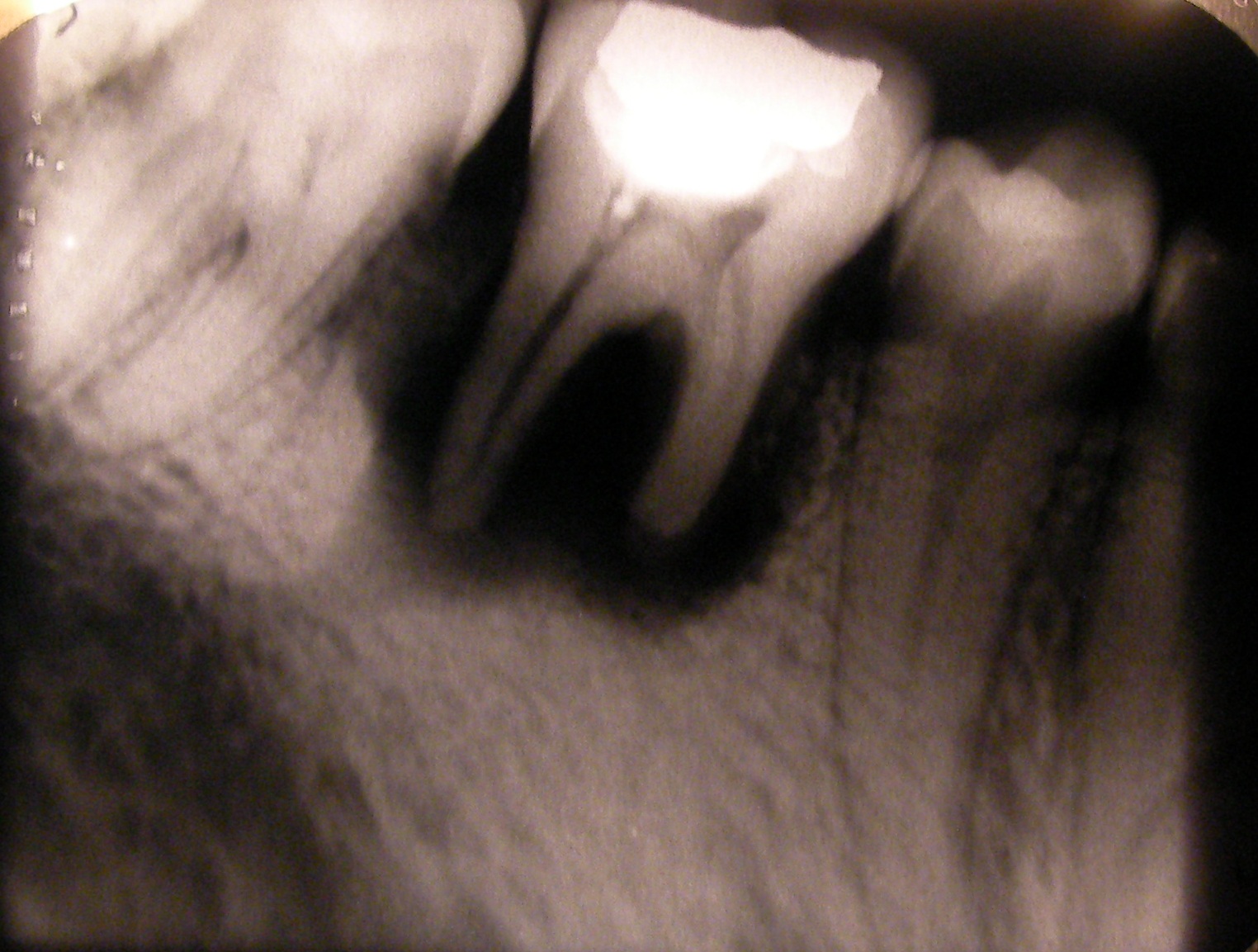
The single most objective sign of infection is radiolucency — a dark area — at the apex (tip) of the root on a periapical X-ray. This indicates bone loss caused by long-standing infection.
However, not every dark spot means a root canal is needed. Shadows under fillings, normal bone anatomy, and even X-ray angle artifacts can look like infections. If the dark area is small or vague, an endodontic second opinion is worth your time.
6. Discoloration of the Tooth (Turning Gray or Dark)
A tooth that turns gray, dark yellow, or brownish over time likely has a dead or dying nerve. This often happens after trauma — even minor trauma you may not remember — but can also result from deep decay.
If the tooth is dark and you also have pain or swelling, a root canal is almost certainly indicated.
7. Pus or Bad Taste Draining from the Tooth
If you notice a salty or foul taste in your mouth, or pus draining from the gum near a specific tooth, an abscess has formed. This means the infection has created a drainage pathway through the bone and gum tissue.
Even if the tooth does not hurt (and many abscessed teeth are surprisingly painless), the infection will not resolve on its own. Without treatment, it can spread to surrounding bone and, in rare cases, into the bloodstream.
3 Signs That Look Like a Root Canal — But Usually Are Not
These three symptoms are the most common reasons patients are told they need a root canal when they actually do not.
Sign 1: Pain Only When Chewing
This is the single most overdiagnosed symptom in dentistry. Pain that occurs only when you bite down is almost always caused by:
- A cracked tooth or cracked filling (not nerve infection)
- A high bite after recent dental work
- Gum inflammation
- A loose filling or crown
For a complete breakdown of why chewing pain rarely requires a root canal, see Tooth Hurts When Chewing — Causes Dentists Miss.
Sign 2: Brief Cold Sensitivity (Under 5 Seconds)
If a sip of cold water makes your tooth twinge for a moment and then stops, the nerve is responding normally. This is reversible pulpitis — inflammation that can heal on its own or with a simple filling.
The key difference is duration. Brief = reversible. Lingering = irreversible.
Sign 3: Pain That Comes and Goes
Tooth pain that appears, disappears for days or weeks, and then returns is rarely a dying nerve. Nerve death is usually progressive — it gets worse over time, not better.
Intermittent pain is much more likely to come from cracks, bite issues, sinus pressure, or gum disease. For a detailed guide, see Tooth Pain Comes and Goes — What It Means & When You Should Worry.
When to Get a Second Opinion
You should consider a second opinion if:
- You have only one or two mild symptoms
- You have no swelling or fever
- The dentist did not perform any sensitivity or bite tests
- You were not shown the X-ray or the problem area
- The diagnosis took less than five minutes
- You feel rushed or pressured
According to the ADA's Code of Professional Conduct, patients have the right to seek a second opinion, and it is unethical for a dentist to discourage you from doing so. If your dentist reacts negatively to the idea of getting another opinion, that's a red flag worth noting. If your dentist reacts negatively to the idea of a second opinion, that is useful information in itself.
For guidance on how to navigate your dentist's recommendation, see Dentist Says I Need a Root Canal — What Should I Do Next?.
What a Real Root Canal X-Ray Looks Like
On a periapical X-ray, a tooth that genuinely needs a root canal typically shows:
- A dark, well-defined circular or oval area at the root tip
- Decay that visibly reaches or approaches the pulp chamber
- A widened periodontal ligament space (the dark line around the root)
What is often misread as needing a root canal:
- Small shadows under old fillings (these are often recurrent decay that can be re-filled)
- Normal trabecular bone patterns (the spongy bone between teeth)
- Overlapping anatomical structures (like the sinus floor near upper molars)
- X-ray artifacts from angle or exposure
If your X-ray looks ambiguous, an endodontist or online second opinion service can give you a clearer read.
What Happens If You Wait?
You don't always need to act immediately. Here's a reasonable timeline:
- No swelling, mild pain: You have days to weeks to decide. A second opinion is safe.
- Swelling but no fever: You should seek care within 24–48 hours.
- Swelling with fever: This is a medical concern. Seek care within hours.
- Facial swelling affecting breathing or vision: Go to the emergency room immediately.
Most non-emergency cases can safely wait 1–2 weeks for a second opinion without meaningful risk of complications.
Root Canal vs Extraction vs Monitoring
| Scenario | Best Option | Why |
|---|---|---|
| Clear infection with symptoms | Root canal | Save the tooth, remove infection |
| Deep decay, nerve exposed | Root canal | Tooth is restorable |
| Crack through the root | Extraction | Tooth cannot be saved |
| Brief cold sensitivity, no X-ray findings | Monitoring + filling | Reversible pulpitis — watch and treat conservatively |
| Pain only when chewing | Bite adjustment or crown | Treat the crack or high bite, not the nerve |
For a more detailed comparison, see Root Canal vs Alternatives: Complete Comparison.
The Cost of a Root Canal
Root canal costs in the United States vary by tooth type and provider:
- Front tooth: $800–$1,500
- Premolar: $900–$1,800
- Molar: $1,200–$2,500
A crown is typically needed afterward, adding $1,000–$3,000. For a complete breakdown, see Root Canal Cost: What to Expect.
An online second opinion at ToothCheck costs $59 and can confirm or question the diagnosis before you spend thousands on treatment.
FAQ
Can a tooth that needs a root canal heal on its own? No. If the pulp is dead or irreversibly damaged, it will not heal. The infection will either stay or spread.
How long can I delay a root canal? Without swelling: weeks. With swelling but no fever: 24–48 hours. With fever: hours.
Is a root canal painful? Modern root canals are performed under local anesthesia and are no more uncomfortable than a filling. The pain you feel before treatment is from the infection, not the procedure.
Do I always need a crown after a root canal? Molars almost always need a crown because they are weaker after treatment. Front teeth sometimes do not, depending on the amount of remaining tooth structure.
Can I get a root canal second opinion online? Yes. Upload your X-rays and symptoms to ToothCheck and get a review in under 72 hours.
Final Advice
Not every toothache needs a root canal. The nerve is remarkably resilient and can recover from inflammation if the cause is addressed early. But if you have spontaneous pain, night pain, lingering sensitivity, or swelling, do not ignore it — get a professional evaluation.
And if your dentist recommends a root canal and you are not entirely convinced, get a second opinion. It is your tooth, your money, and your health.
Upload your X-rays to ToothCheck for an independent review in under 72 hours.
References: 1. American Association of Endodontists. Root Canal Treatment. https://www.aae.org/patients/root-canal-treatment/ 2. Journal of Endodontics. Diagnostic disagreement in endodontic treatment planning. 2023. 3. International Endodontic Journal. Predictive value of night pain for irreversible pulpitis. 2021. 4. American Dental Association. Code of Professional Conduct. https://www.ada.org/about/governance/ada-code-of-ethics 5. PubMed. Reversible vs irreversible pulpitis: clinical diagnostic criteria. PMC Journal.
Last medically reviewed: June 2026